
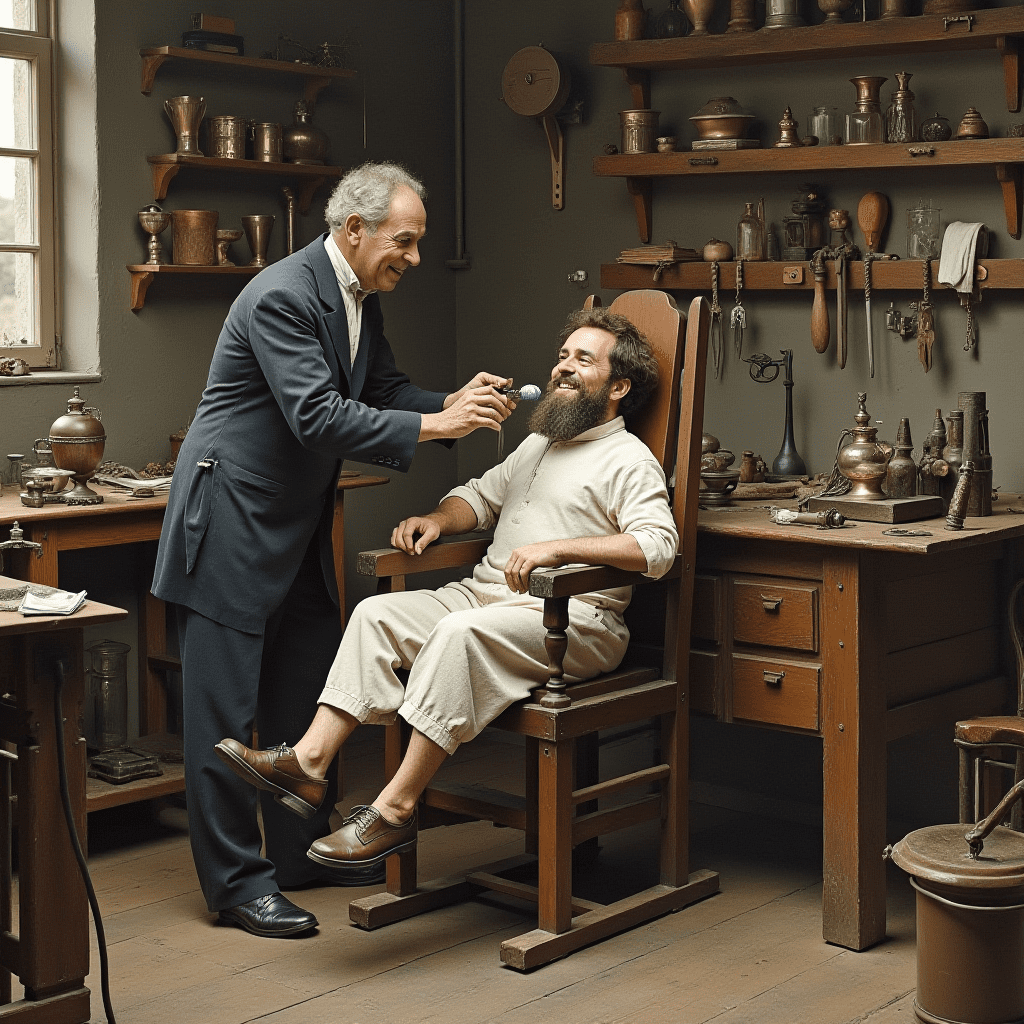
Imagine this: you walk into a dentist’s office, the familiar scent of antiseptic in the air, the whirring of a drill somewhere in the background. You settle into the chair, perhaps a little nervous, but expecting a filling or a cleaning. Now, imagine that same dentist emerging from the back room, not with a mirror and probe, but with a contraption designed for something far more permanent, and far more final. Sounds like a fever dream, right? Prepare yourself, because this isn’t fiction. This is the unbelievable, yet true, story of how a dentist played a pivotal role in developing one of history’s most chilling inventions: the electric chair.
Let’s rewind a bit, shall we? It’s the late 19th century, a time of rapid innovation and a growing unease with the traditional methods of capital punishment. The gallows were still the grim standard, but they were seen by many as barbaric, inefficient, and frankly, quite gruesome. There had to be a better way, a more humane, a more *modern* way to execute criminals. This wasn’t about wanting people to die; it was about wanting the *process* to be less… messy. Enter the age of electricity. It was the shiny new marvel, powering homes, lighting cities, and promising to revolutionize everything. So, why not justice?
The idea of using electricity for execution wasn’t born in a vacuum. There was a fierce debate raging about the best method. Various inventors and thinkers were proposing different gruesome solutions. But the surge of interest in electricity presented a unique, and some thought, more scientific approach. The problem was, how do you harness this new, powerful force to ensure a quick and painless death? It needed someone who understood the human body, its vulnerabilities, and how electricity might interact with it. And that’s where our dentist comes in.
His name was Alfred P. Southwick. He was a respected dentist in Buffalo, New York. But Southwick wasn’t just any dentist; he was also a deeply principled man who was horrified by the cruelty he perceived in public executions. He believed in scientific progress and was fascinated by the potential of electricity. The story goes that he was inspired by a rather grim observation he made after witnessing an elderly drunkard accidentally touch a live wire following a storm. The man died instantly, with what appeared to be minimal suffering. This sparked an idea, a dark, revolutionary idea.
Southwick, with his knowledge of anatomy and physiology, began to experiment and theorize. He wasn’t thinking about fillings and crowns anymore. He was thinking about circuits, voltage, and the precise application of electrical current to the human body. He envisioned a contrivance, a special chair, designed to deliver a lethal jolt. Imagine the conversations: ‘Dr. Southwick, how is that implant coming along?’ ‘Oh, you know, just refining the terminal placements for optimal conductivity. It’s for a… very special patient.’ It sounds absurd now, but this was the genuine thought process.
He wasn’t alone in this pursuit. The state of New York was actively seeking a more humane method of execution, and they formed a commission to explore alternatives. Southwick was a vocal member of this commission, readily sharing his designs and his conviction that electricity was the future of capital punishment. His dental background, while seemingly unrelated, gave him a unique perspective. He understood the delicate tissues, the nerve pathways, and how a controlled electrical current could disrupt vital functions. It was a macabre application of his medical expertise.
The development wasn’t smooth sailing. There were countless trials, experiments, and debates. Early demonstrations involved animals, which, as you can imagine, weren’t exactly enthusiastic volunteers. The goal was to find the right amount of voltage and the right duration to ensure immediate death. It was a race against the gallows, a quest for a ‘scientific’ death. Southwick, in his capacity as a dentist and as a member of the death penalty commission, was at the forefront of this push.
Finally, in 1888, New York adopted electrocution as its official method of execution. And the very first person to be put to death in this new, scientifically ‘improved’ way? William Kemmler, on August 6, 1890. The device used was based on the principles and designs that Southwick had championed. It was a stark, dark culmination of his work, a testament to how innovation, even with the best intentions of reducing suffering, can lead to horrifying outcomes.
Think about that for a moment. The tools of healing, the instruments used to mend teeth and alleviate pain, were being re-imagined, albeit indirectly, for a completely different, and grim purpose. It’s a powerful reminder that inventions can have unintended, and often disturbing, consequences. The legacy of the electric chair is complex and deeply troubling, a stain on the history of justice systems worldwide. But at its origin, at the very spark of its conception, was a dentist with a vision for a cleaner, more ‘modern’ way to die.
So, the next time you’re sitting in that dentist’s chair, perhaps you’ll have a slightly different perspective. It’s a story that’s both fascinating and chilling, proving that sometimes, the most unexpected individuals can shape the course of history in the most profound, and at times, terrifying ways. The tale of Alfred P. Southwick, the dentist who electrified justice, is one that truly makes you stop and think. What other everyday professions might have darker, untold stories connected to them? The world is full of surprising truths waiting to be uncovered.