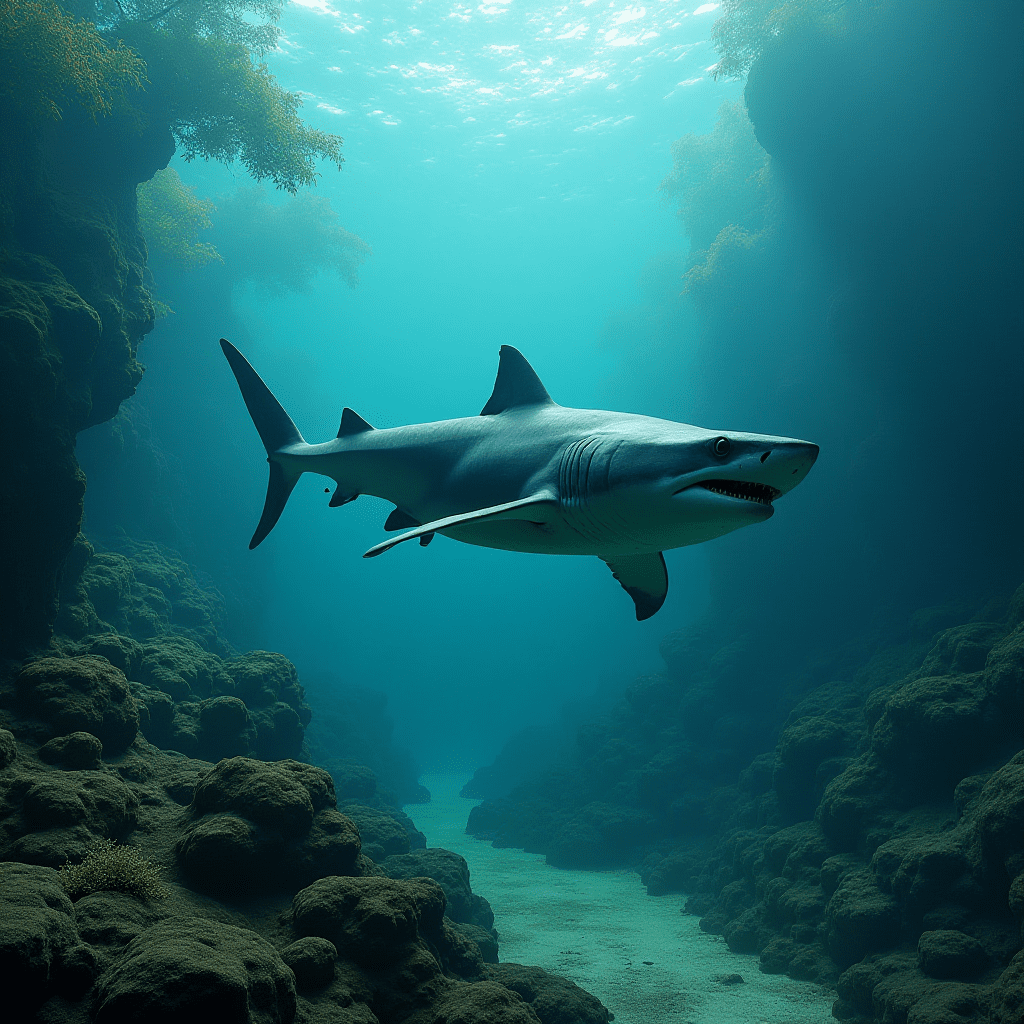
Close your eyes for a second. Now, picture this: vast, ancient oceans. Sunlight filters through the murky depths, illuminating a world teeming with life. But what kind of life? Forget towering redwoods, forget whispering pines. Forget the very idea of a forest. Because in this deep, primordial time, the dominant force, the apex predator, the undisputed king of the waves… was a shark.
Yes, you read that right. Sharks. Those sleek, powerful creatures we often associate with modern-day oceans, with thrilling documentaries and a healthy dose of fear, have a history so ancient it makes the oldest trees look like saplings. We’re talking about a lineage that predates the very concept of land-based forests by hundreds of millions of years. It’s a mind-bending thought, isn’t it?
Think about the iconic image of a mighty oak, its branches reaching for the sky, its roots delving deep into the earth. Trees are symbols of endurance, of time, of life’s resilience. We see them as ancient, as foundational to our world. But the truth is, the ancient oceans were already a wild, shark-infested frontier long before the first seed even sprouted on dry land.
Let’s rewind the clock. Way, way back. We’re talking about the Devonian period, often called the ‘Age of Fishes’. This was roughly 400 million years ago. The Earth was a very different place. The continents were in different places, the atmosphere was different, and life was primarily aquatic. And in these ancient waters, sharks were already a formidable presence. Some of these early sharks were a far cry from the great whites and hammerheads we know today. They were often armored, with bony plates and strange appendages, but they were undeniably sharks, perfectly adapted to their watery domain.
Now, fast forward a bit. Trees, as we understand them, started to emerge and diversify much later, around the end of the Silurian period and into the Devonian. The first true forests, with primitive ferns and lycophytes, began to carpet the nascent landmasses. This was a monumental shift in Earth’s history, paving the way for land-based life as we know it. But even as trees were taking their first tentative steps onto land, sharks were already ancient mariners, having navigated the oceans for tens of millions of years.
Consider the sheer scale of this. Sharks have witnessed the rise and fall of countless species. They’ve survived mass extinctions that wiped out the majority of life on Earth, including many of the creatures that shared their ancient watery world. They’ve seen continents drift, mountains rise and fall, and climates shift dramatically. And through it all, the fundamental blueprint of the shark, the essence of what makes it a shark, has remained remarkably consistent.
This isn’t just a fun fact to drop at parties (though it is incredibly cool!). It’s a profound reminder of the incredible depth and resilience of life on our planet. It paints a picture of a world where the ocean was the primary stage for evolution for an unfathomably long time, and sharks were the seasoned performers.
Imagine the early sharks. No coral reefs as we know them, no kelp forests swaying in the current. Just vast, open water, punctuated by volcanic islands and shallow, primeval seas. They were hunting trilobites, early crustaceans, and other strange marine invertebrates. They were the undisputed masters of this ancient realm, honing their predatory instincts and perfecting their streamlined forms.
The evolution of trees brought about a revolution on land. Forests created new habitats, changed atmospheric composition, and allowed for the evolution of land animals. It was a complete game-changer for the planet. But in the ocean, the sharks continued their reign. They adapted to changing prey, evolving alongside the marine life that shared their environment.
When we think about prehistoric creatures, we often jump to dinosaurs. And dinosaurs are indeed fascinating, ruling the land for millions of years. But their reign, while epic, started much, much later than the shark’s tenure. Sharks were already ancient history by the time the first dinosaurs took their first steps. They were the original survivors, the long-hailed titans of the deep.
This longevity is what makes sharks so remarkable. Their evolutionary journey spans an incredible swathe of Earth’s history. They’ve had more time to refine their survival strategies, their incredible senses, and their formidable hunting prowess than almost any other group of animals. It’s a testament to their perfect design, a design that has stood the test of time.
The next time you see a shark, whether in a documentary or perhaps even on a diving trip (from a safe distance, of course!), take a moment to truly appreciate its lineage. You’re looking at a creature whose ancestors were patrolling the seas when the Earth was still a very different, very watery planet. You’re witnessing a living fossil, a direct link to a time before the whispering leaves and the sturdy trunks of trees dominated the landscape.
It’s a story of persistence, adaptation, and an enduring mastery of the marine world. Sharks are more than just predators; they are living history books, their cartilaginous skeletons holding the secrets of an ancient Earth. They remind us that sometimes, the most incredible stories aren’t the ones that are loudest or flashiest, but the ones that have quietly endured, swimming through the ages, long before anything else we know even had a chance to grow.
So, next time you’re contemplating the wonders of nature, remember the silent swimmers. Remember the sharks. They were here first. They’ve seen it all. And they’re still here, a powerful reminder of the planet’s incredible, ancient past. Isn’t that something to think about the next time you’re walking through a forest?
The sheer fact that sharks have been around for so long, outlasting so many other incredible life forms, is a testament to their incredible evolutionary success. They are a vital part of our marine ecosystems today, and their ancient lineage continues to inspire awe and wonder. It’s a humbling perspective on our place in the grand timeline of life.