
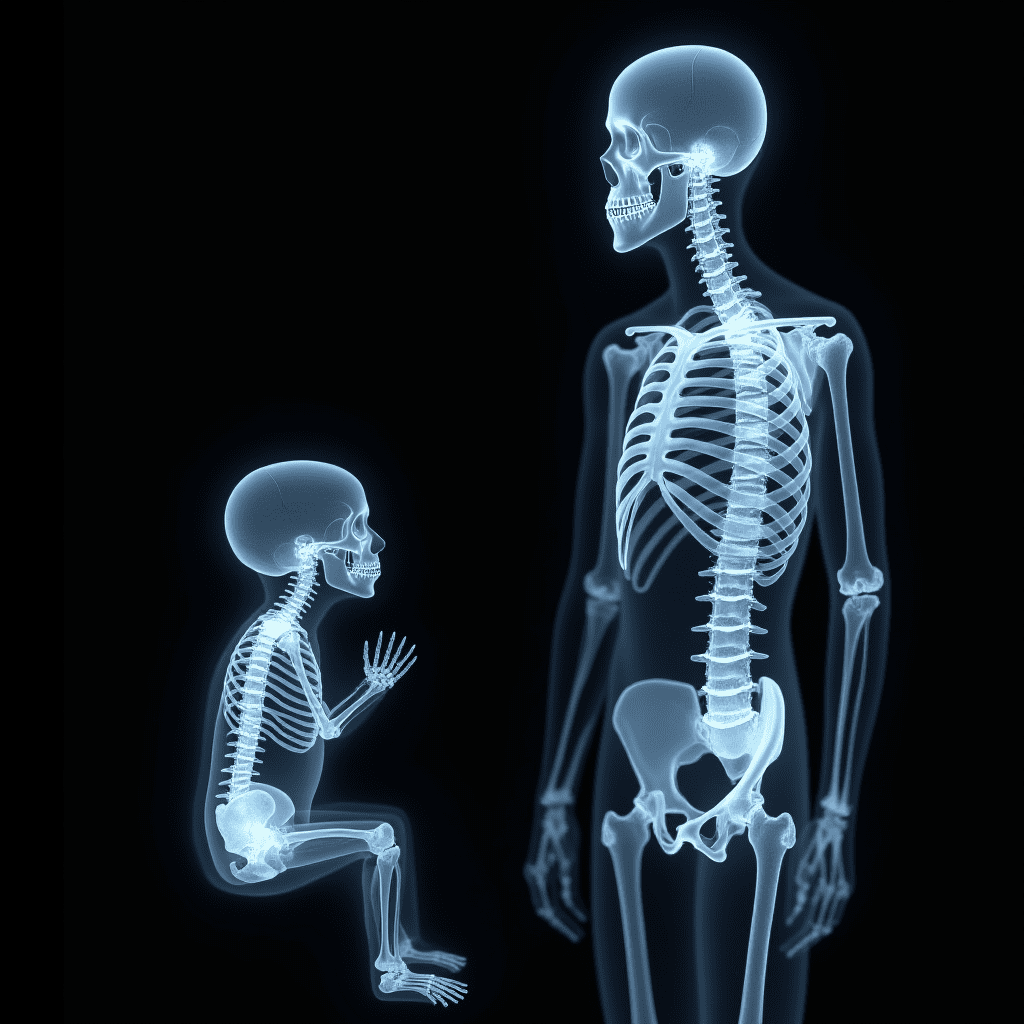
Imagine this: you’re holding your brand-new baby, a perfect little miracle. You marvel at their tiny fingers, their delicate toes, their impossibly small nose. You might even be counting their fingers and toes, a ritual many new parents perform. But what if I told you that this seemingly simple count is just the tip of the iceberg, and that your little one possesses a secret bone bonus that will astonish you?
It’s true. The tiny bundle of joy nestled in your arms, or perhaps the energetic toddler taking their first wobbly steps, has more bones than you do. Yes, you, the fully grown adult with all your aches and wisdom, are outnumbered in the bone department by your own offspring. Mind. Blown.
Let’s rewind. Think back to your own childhood. Were you ever fascinated by the human skeleton? Maybe you saw a model in a science class, or perhaps a spooky Halloween decoration. You probably learned that adults have a set number of bones – around 206, if memory serves. It’s a fact that many of us carry with us, a neat little piece of trivia.
But here’s where the story gets truly interesting, and a little bit magical. When a baby is born, they enter the world with an astonishing number of bones – somewhere in the ballpark of 300! Wait, what? 300? How can that be? They’re so small!
This isn’t a trick of the light, or some kind of biological anomaly. It’s a fundamental part of how we grow and develop. Think of it like building with LEGOs. You start with lots of small, flexible pieces, and as you build, some of those pieces fuse together to create a stronger, more stable structure.
Our skeleton starts out as a collection of softer, more pliable cartilage. This cartilage is crucial in those early stages. Why?
Flexibility is Key
One of the biggest reasons for this difference lies in childbirth itself. Imagine a baby trying to navigate the narrow birth canal with a rigid, fused skeleton. It would be a much more challenging, and potentially dangerous, journey for both mother and child. The softer, more separated bones in a baby’s skull, for instance, allow them to mold and compress slightly, making their passage possible.
Beyond birth, this flexibility is essential for growth. As babies grow, their bodies are constantly changing and expanding. Having more, smaller bone segments allows for easier growth and development. It’s like having lots of little building blocks that can rearrange and expand as needed, rather than a few giant, unmovable ones.
So, where do these extra bones go? This is where the fascinating process of ossification and fusion comes into play. Ossification is the process where cartilage is replaced by bone. As a baby grows, many of these smaller bones gradually fuse together.
Think about the skull again. A newborn’s skull isn’t a single solid piece. It’s made up of several plates that are not yet fully joined. These gaps, called fontanelles (or soft spots), are vital. They not only help with the birthing process but also allow the brain to grow rapidly in the first year of life. As the brain reaches its adult size, these plates gradually fuse, forming the solid, protective skull we recognize in adults.
Similarly, the bones in a baby’s spine are more numerous and separated. As they grow, these segments fuse, allowing for the development of a strong, supportive backbone. The same applies to the bones in the arms and legs, the pelvis, and even the sternum.
It’s a remarkable evolutionary adaptation. This intricate process ensures that we develop into strong, mobile individuals. The initial abundance of bones provides the necessary flexibility and room for growth, and the subsequent fusion creates the robust skeletal structure we need for lifelong support and movement.
This biological marvel highlights the incredible complexity and adaptability of the human body. It’s a constant reminder that development isn’t a simple process of adding things, but often involves transformation and integration.
Consider the practical implications. This is why babies are so wonderfully pliable. You can gently move their limbs, and they don’t seem to have the same stiffness we might associate with adult joints. It’s all thanks to that initial, more numerous bone structure.
It’s also why we sometimes hear about babies being able to do things that seem impossible for adults, like touch their heels to their head (with a lot of help, of course!). Their more flexible skeletal system contributes to this remarkable range of motion.
As parents, we often focus on the milestones: first smile, first tooth, first step. But beneath the surface, there’s this incredible, silent transformation happening within our children’s bodies. The very foundation of their physical being is undergoing a profound metamorphosis.
So, the next time you’re gazing at your little one, remember the incredible bone symphony playing out within them. They’re not just cute and cuddly; they’re a testament to biological ingenuity, a work in progress that will, over time, consolidate its many parts into the 206 bones that will carry them through life.
It’s a powerful thought, isn’t it? That the very thing that makes them so vulnerable and dependent in their early days is also the key to their future strength and mobility. The story of a baby’s bones is a story of growth, adaptation, and the beautiful, ongoing journey of becoming.
Isn’t it amazing how much we can learn from observing the natural world, and even our own bodies? This little-known fact about baby bones is just one example of the wonders that surround us. Share this fascinating tidbit with your friends and family, and let’s celebrate the incredible science behind human development!
Did you know this about baby bones? What other surprising biological facts have you come across? Let us know in the comments below!
#BabyFacts #HumanBody #ScienceIsCool #Parenting #DidYouKnow #ForRealPost