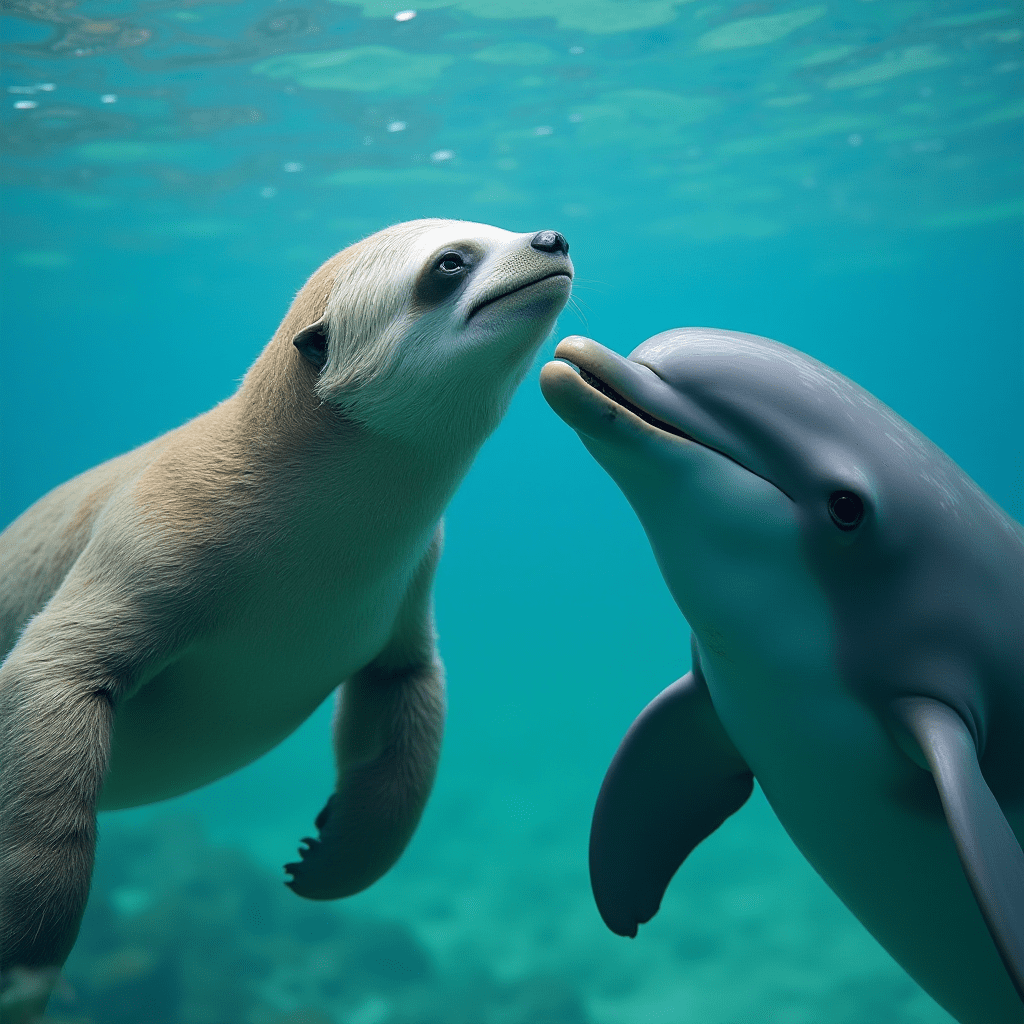
Imagine this: you’re staring into the deep blue, captivated by the sleek, powerful form of a dolphin leaping through the waves. You marvel at its agility, its speed, its seemingly endless ability to play in the ocean. You think, surely, this is the champion of breath-holding, a master of the aquatic realm. But what if I told you that the true champion, the undisputed king of holding its breath, is a creature that spends most of its life hanging upside down in a tree, moving at a pace that makes molasses look like a race car?
Yes, you read that right. We’re talking about sloths. Those fuzzy, slow-moving mammals that seem to doze their way through life. They’re known for their incredible laziness, their penchant for napping, and their generally chill demeanor. But beneath that placid exterior lies a biological marvel that puts even the most accomplished marine mammals to shame.
Let’s set the scene. Picture a lush, humid rainforest. Sunlight filters through the dense canopy, painting dappled patterns on the forest floor. High above, a three-toed sloth, perhaps a brown-throated sloth, is meticulously making its way along a branch. Its movements are deliberate, almost glacial. It reaches out a long, curved claw, grasps the next branch, and slowly, painstakingly, pulls itself forward.
Now, let’s introduce our sleek competitor: the dolphin. We see them in documentaries, effortlessly diving to incredible depths, holding their breath for minutes on end as they hunt, play, and navigate their underwater world. We’ve always associated that incredible breath-hold capacity with these ocean giants. They are, after all, perfectly adapted for life in the water.
But here’s the mind-bending fact that will change how you view these two seemingly disparate creatures: sloths can hold their breath for an astonishingly long time. We’re talking about a sloth’s ability to survive underwater for several minutes, sometimes even up to 40 minutes in extreme circumstances. Forty minutes! That’s longer than most humans can comfortably hold their breath while doing absolutely nothing, let alone swimming.
Compare that to dolphins. While dolphins are incredibly adept at holding their breath, their typical dive times range from 8 to 10 minutes, with some trained individuals or specific species pushing it a bit further. Still impressive, no doubt. But when you stack that up against a sloth’s potential 40 minutes? The numbers tell a story you probably never expected.
How is this possible? How can a creature that appears so ill-suited for aquatic adventures possibly outperform a dedicated marine mammal? The answer lies in a remarkable biological adaptation that scientists are still actively studying. It’s a testament to the incredible diversity and ingenuity of nature.
One of the key factors is the sloth’s incredibly slow metabolism. Everything about a sloth is slow. Their heart rate is exceptionally low, beating as little as 30 times per minute, and can drop to as low as 20 beats per minute when submerged. This drastically reduces their oxygen consumption. Think of it like a car with amazing fuel efficiency; it can go much further on less.
When a sloth decides to take a dip, whether it’s to cross a river or perhaps escape a predator (though their primary defense is camouflage and being incredibly hard to find), their body prepares for this unusual event. Their heart rate slows even further, and their peripheral blood vessels constrict, shunting precious oxygenated blood to the vital organs like the brain and heart. It’s a shutdown of non-essential functions to preserve what’s most important.
And then there’s the sheer efficiency of oxygen utilization. Sloths have evolved to get the absolute most out of every single breath. Their blood is also remarkably good at binding to oxygen, meaning they can carry more oxygen with less blood volume. It’s a masterclass in biological engineering, honed over millions of years.
The implications of this fact are staggering. It challenges our preconceived notions about animal capabilities. We tend to categorize animals based on their most obvious traits. Dolphins are water creatures, so they hold their breath. Sloths are tree creatures, so they move slowly. But nature loves to surprise us, and the sloth is a prime example of this.
Think about the sloth’s lifestyle. They often descend from trees only about once a week to defecate. During these excursions, they might have to cross streams or small bodies of water. So, evolution has clearly favored a way for them to manage these aquatic challenges without panicking or needing to find a bridge. Holding their breath for extended periods is the perfect solution.
This isn’t some obscure trivia that you’ll never use. This is a genuine, awe-inspiring fact about the animal kingdom that reveals the hidden depths of even the most seemingly ordinary creatures. It makes you wonder what other incredible abilities are lying dormant, waiting to be discovered in the natural world.
So, the next time you see a picture of a sloth, don’t just think about its slow pace. Think about its hidden superpower. Think about its ability to outlast a dolphin in a breath-holding contest. It’s a reminder that appearances can be deceiving, and that the slowest among us might just be the most resilient.
This amazing adaptation is a key reason why sloths are such fascinating subjects for zoologists and nature enthusiasts. Their unique physiology allows them to thrive in their arboreal habitat, with the added bonus of being surprisingly capable in the water. It’s a perfect example of how evolution shapes species to meet the specific demands of their environment.
It’s a story that’s still unfolding, with ongoing research shedding more light on the intricate mechanisms that allow sloths to achieve these incredible feats. The more we learn, the more we appreciate the complexity and wonder of life on Earth. The humble sloth, often overlooked, has proven itself to be a true champion in its own right.
So, let this sink in: sloths, the epitome of slow and steady, possess a breath-holding capacity that surpasses that of the sleek and agile dolphin. It’s a wild, wonderful fact that truly makes you stop and rethink your understanding of the animal kingdom. Nature, it seems, has a sense of humor and a genius for surprising us in the most unexpected ways. Share this incredible fact with your friends and let’s marvel at the wonders of the natural world together!