
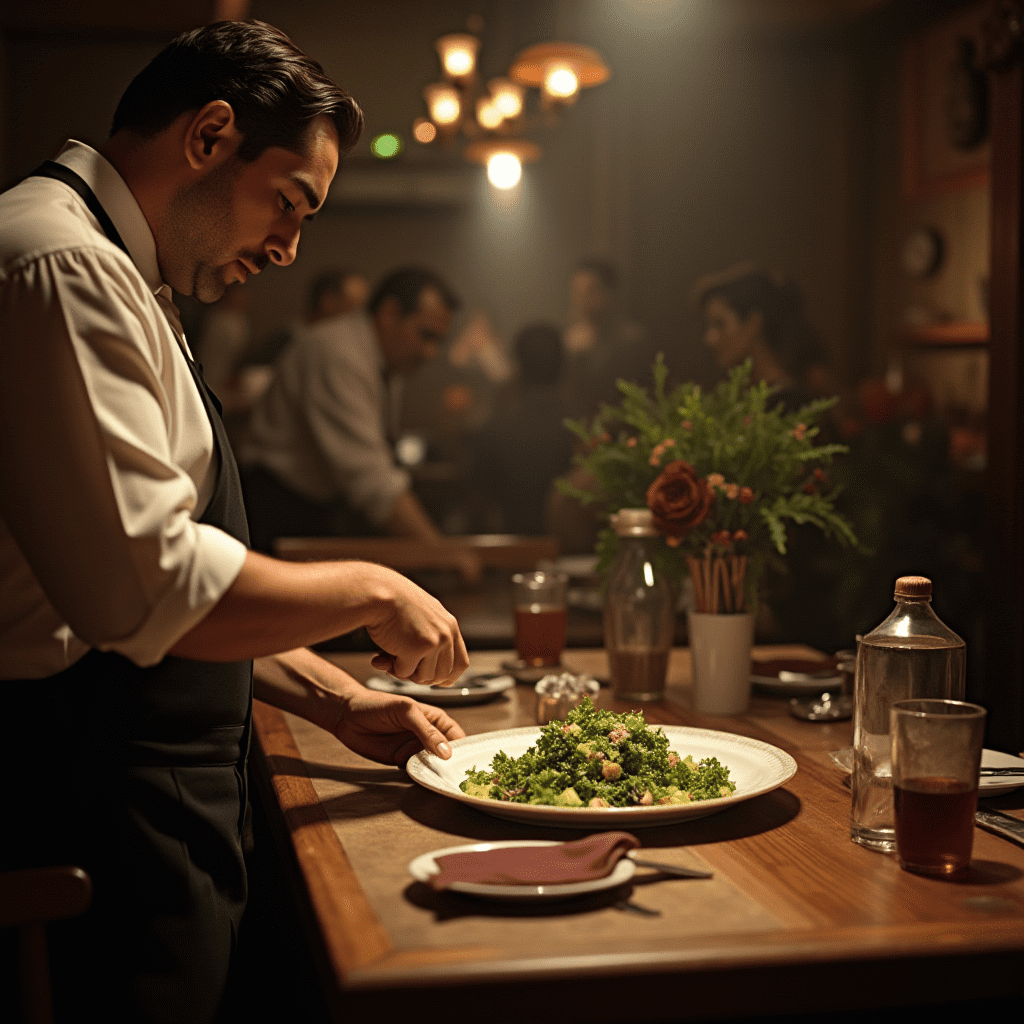
Picture this: you’re at a swanky restaurant, the kind with white tablecloths and hushed conversations. You order a Caesar salad. Crisp romaine, creamy dressing, crunchy croutons, a hint of Parmesan. It feels… classic. Perhaps even Roman.
But what if I told you that this beloved salad, a staple on menus worldwide, has roots that are decidedly *not* Italian?
What if I told you it was born in Mexico?
I know, I know. It sounds like a culinary conspiracy theory. The name itself, ‘Caesar,’ conjures images of emperors and ancient empires, not tacos and tequila. But stick with me, because the true story of the Caesar salad is far more fascinating, and a whole lot more delicious, than you might ever have guessed.
Our journey begins not in the hallowed halls of a Roman senate, but in the vibrant, bustling border town of Tijuana, Mexico.
It was the Prohibition era, the 1920s. America was dry, and Mexico, just a stone’s throw away, was very, *very* wet. This created a unique phenomenon: Americans flocked across the border to enjoy a good drink and, as it turned out, some incredible food. Tijuana became a playground for the thirsty and the adventurous.
And in the heart of this lively scene was a restaurant called Caesar’s.
This wasn’t some back-alley dive. Caesar’s was an upscale establishment, a destination. Its owner? A man named Caesar Cardini.
Now, Caesar Cardini was an Italian immigrant. He had a flair for the dramatic and a talent for hospitality. He ran a successful restaurant in San Diego, but with Prohibition, he saw an opportunity across the border. He packed up and headed to Tijuana, opening Caesar’s restaurant in 1923.
Life in a popular border town restaurant could be unpredictable. One busy holiday weekend – the Fourth of July, 1924, to be exact – the kitchen at Caesar’s found itself in a bit of a pickle. The restaurant was packed, the diners were hungry, and supplies were running low. Panic could have set in. But Caesar Cardini wasn’t just any restaurateur; he was a resourceful one.
He surveyed his pantry. What did he have on hand? He had lettuce. He had eggs. He had Worcestershire sauce, garlic, olive oil, bread, and Parmesan cheese. He certainly didn’t have a fully stocked pantry ready for a massive influx of customers.
Instead of admitting defeat or sending someone on a frantic dash to the market, Caesar decided to improvise. He decided to create something spectacular out of what he had.
Legend has it that he gathered the fresh romaine lettuce, tossed it with a dressing he whipped up on the spot, and then, with showmanship, tossed it with croutons that had been fried in garlic-infused olive oil, grated Parmesan cheese, and a flourish of Worcestershire sauce. He likely cracked a coddled egg into the dressing for creaminess, a technique that would become characteristic of the authentic Caesar.
The customers were, to put it mildly, enthralled.
The salad was a sensation. It was simple, yet elegant. Fresh, flavorful, and prepared tableside with a certain theatrical flair that delighted the patrons. Word spread like wildfire. People weren’t just coming to Tijuana for the drinks anymore; they were coming for Caesar’s salad.
This impromptu culinary creation quickly became a signature dish. It was so popular that it was added to the regular menu, and its fame grew exponentially. Celebrities and dignitaries who visited Tijuana during Prohibition would rave about this unique salad, bringing its delicious reputation back with them to the United States.
Now, there are always debates and competing claims when it comes to food origins. Some stories suggest that Caesar’s brother, Alex Cardini, or an employee named Livio Santini, might have played a role. Some even claim a similar dish existed elsewhere. However, the most widely accepted and documented account points to Caesar Cardini himself and the events of that busy holiday weekend in Tijuana.
Think about it. The name ‘Caesar’ fits perfectly with Caesar Cardini. The location, Tijuana, makes sense given the Prohibition-era migration. The ingredients, while not exotic, were readily available and could be assembled into something extraordinary.
So, the next time you enjoy a Caesar salad, take a moment to savor its Mexican heritage. It’s a testament to ingenuity, resourcefulness, and the power of a simple, perfectly executed dish.
It’s a salad that conquered the world, starting from a humble kitchen in a vibrant border town. It’s a story that reminds us that culinary greatness can bloom in the most unexpected places, often born from necessity and a dash of genius.
And the secret? It’s likely the freshness of the ingredients, the emulsified dressing made with a coddled egg, the crunchy garlic croutons, and that sprinkle of Parmesan. Simple, yet divine.
So, let’s raise a fork to Caesar Cardini, the Mexican inventor of the Caesar salad! It’s a delicious piece of history, served on a bed of crisp romaine. A true ForRealPost if there ever was one!
What do you think of this revelation? Were you as surprised as I was? Let me know in the comments below! And if you love this story, share it with your friends who are also salad lovers – they’ll never look at their Caesar the same way again!