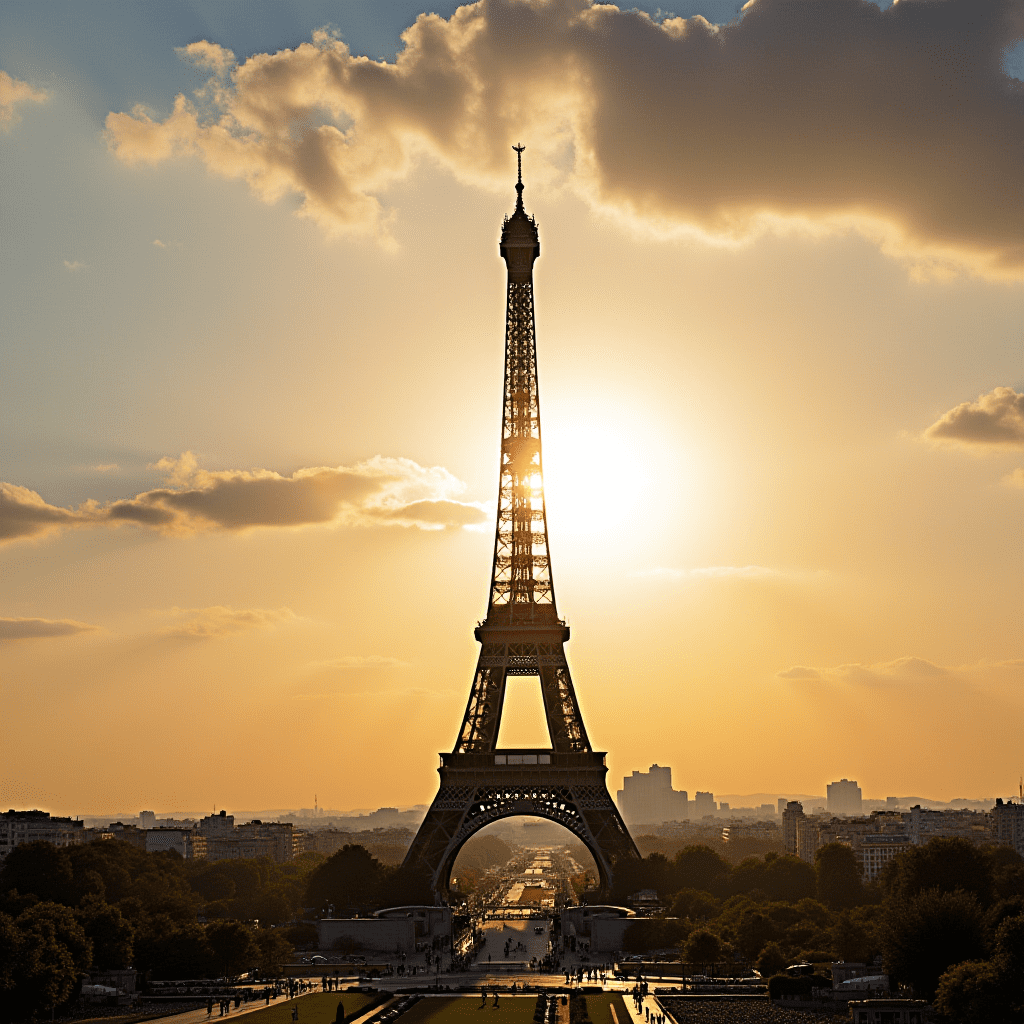
Imagine this: You’re standing in Paris, the sun is beating down, and you’re gazing up at the magnificent Eiffel Tower. It’s a sight that takes your breath away, a symbol of romance and architectural genius. But what if I told you that, on a particularly hot Parisian day, that iconic structure could be… taller? Not just in your imagination, but actually, measurably taller.
Before you call the tour guides, I’m not talking about some magical expansion. This is science, and it’s pretty darn cool. It’s a phenomenon that affects almost everything around us, but it’s most dramatically visible when you’re looking at one of the world’s most famous landmarks.
So, how does this happen? It all comes down to a concept you probably learned about in school: thermal expansion. You know how metal expands when it gets hot, right? Think about a railroad track on a scorching summer day – it looks a little wavy. That’s the same principle at play, just on a colossal scale.
The Eiffel Tower, as you know, is made of iron. Lots and lots of iron. Specifically, it’s constructed from around 18,000 individual pieces of wrought iron, meticulously riveted together. Iron, like most materials, expands when heated and contracts when cooled.
And guess what’s really good at heating things up? The sun. Especially the powerful summer sun that bathes Paris in warmth. As the sun’s rays hit the iron structure, the metal heats up. And as it heats up, it expands.
This expansion doesn’t happen all at once, or in a way that’s immediately obvious to the casual observer. It’s a gradual process throughout the day. The sun warms the iron, the iron molecules get more energetic and move further apart, causing the metal to lengthen.
Now, we’re not talking about a few millimeters here. Over the course of a hot summer, the cumulative effect of this thermal expansion can be quite significant. Engineers and scientists who study the Eiffel Tower have measured its height, and the results are fascinating.
During the peak of summer, when temperatures soar, the Eiffel Tower can actually gain as much as 15 centimeters in height. That’s almost six inches! Imagine that – a structure over 300 meters tall suddenly getting a little bit taller, all thanks to the sun.
It’s a testament to the incredible engineering that went into building the tower in the first place. Gustave Eiffel and his team were brilliant minds, and they accounted for these natural forces. They knew that the massive iron structure would be subjected to temperature fluctuations and designed it to withstand them.
Think about the sheer amount of iron involved. That’s a lot of material that, when heated, wants to expand. The design had to accommodate this expansion and contraction without compromising the tower’s stability or integrity. It’s a delicate balancing act.
This phenomenon isn’t unique to the Eiffel Tower, of course. Bridges, skyscrapers, even your car’s exhaust pipe all experience thermal expansion. But the Eiffel Tower, with its open lattice structure and its immense size, makes it a perfect, and very public, demonstration of this scientific principle.
So, the next time you’re planning a trip to Paris, or even just dreaming about it, remember this little piece of trivia. If you visit during the summer months, you’re looking at the slightly, subtly, but undeniably taller Eiffel Tower.
It’s a reminder that even the most solid, seemingly immutable structures are still subject to the gentle, yet powerful, forces of nature. It’s a constant dance between human ingenuity and the natural world.
This isn’t just about a quirky fact; it’s about appreciating the science behind the marvel. It’s about looking at something familiar and discovering a hidden layer of wonder. It’s about how the world around us is always subtly shifting, always responding to its environment.
So, while you might not be able to see the expansion happening with your own eyes, knowing that the Eiffel Tower is playing its own little game of growth with the summer sun adds another layer of magic to its already enchanting presence. It’s just one more reason to fall in love with this Parisian icon.
Next time you see a picture of the Eiffel Tower or plan your visit, think about that extra 15 cm. It’s a little bit of science, a little bit of nature, and a whole lot of amazing engineering, all bundled up into one of the most recognizable structures on Earth. It’s a ForRealPost you won’t forget!