Forget everything you think you know about rain. Forget gentle drizzles, forget torrential downpours. Now, picture this: storms so intense, they forge diamonds. Not tiny, microscopic specks, but honest-to-goodness, glittering gemstones. And guess what? This isn’t a scene from your favorite sci-fi movie. This is happening, right now, billions of miles away, on the colossal gas giants of our solar system: Jupiter and Saturn.
When we look up at the night sky, we often see planets as distant, serene orbs. We imagine swirling clouds and immense pressures, but the sheer, mind-bending beauty of what actually transpires within those swirling atmospheres is something truly extraordinary. It’s a cosmic spectacle that redefines what we consider possible, a testament to the incredible, unbridled power of the universe.
For years, scientists have theorized about the extreme conditions within the hearts of gas giants. The immense pressures, the scorching temperatures, the unique atmospheric compositions – they all pointed to possibilities that seemed almost too fantastical to be real. But as our understanding of these planets has grown, so too has the evidence supporting these incredible theories.
Let’s start with the king of planets, Jupiter. Imagine descending through its thick, swirling atmosphere. You’d encounter layers upon layers of hydrogen and helium, compressed by unimaginable forces. As you go deeper, the temperatures rise, and so does the electrical activity. Lightning storms on Jupiter are legendary, dwarfing anything we’ve ever witnessed on Earth. But it’s not just about electrical discharges.
Deep within Jupiter’s atmosphere, something truly remarkable occurs. The intense pressure and heat are so extreme that they begin to break down the methane molecules present. Think of it like this: the very building blocks of simple gases are being squeezed and battered until they reform into something far more structured and beautiful.
Carbon, the same element that forms the basis of life on Earth, is abundant in Jupiter’s atmosphere. Under these crushing conditions, the carbon atoms begin to bond together. The process is slow, painstaking, and utterly dependent on the extreme environment. It’s a slow-motion alchemy, transforming simple gas into something infinitely more precious.
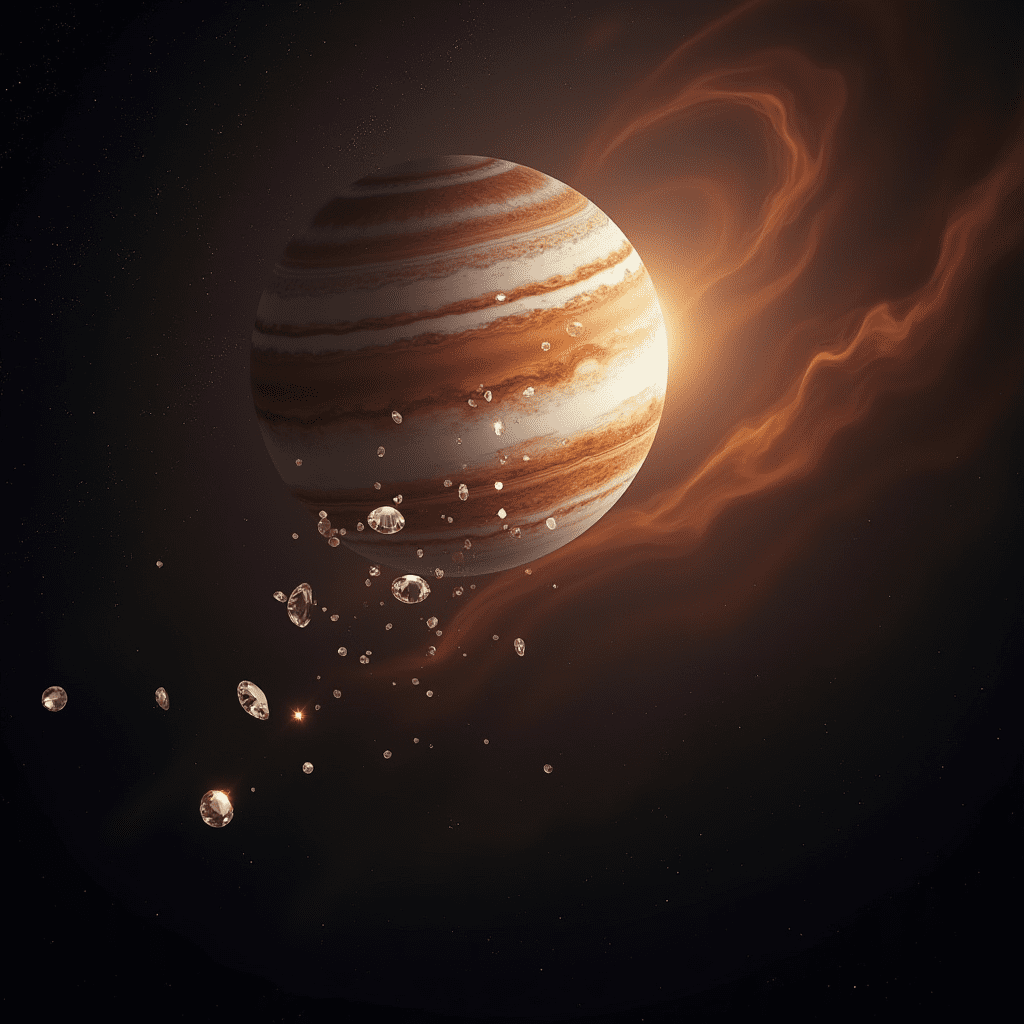
As these carbon atoms coalesce, they form small, crystalline structures. These are the nascent diamonds. They’re not falling as solid chunks right away, mind you. They start as tiny, almost microscopic crystals, suspended in the dense atmosphere. It’s a gradual process, a cosmic crystallization happening on a scale we can barely comprehend.
But the journey doesn’t end there. These tiny diamond crystals continue to fall, buffeted by the powerful winds and storms of Jupiter. As they fall deeper into the planet, the pressure and heat increase even further. This intense environment causes the crystals to grow, to become larger, and more perfect.
Scientists believe that in the very deepest, hottest layers of Jupiter’s atmosphere, these diamond crystals might even melt, forming oceans of liquid diamond. Imagine that – vast, shimmering seas of molten precious stones, churning under the immense gravitational pull of the planet. It’s a scene that is both terrifying and breathtakingly beautiful. This is the reality of Jupiter’s interior.
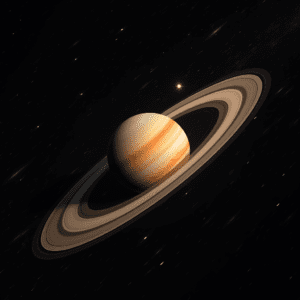
Now, let’s turn our gaze to Saturn, the ringed jewel of our solar system. While perhaps not as massive as Jupiter, Saturn is still an immense gas giant, and its atmosphere holds its own secrets of diamond formation. The conditions on Saturn are remarkably similar to those on Jupiter, albeit with some subtle differences in temperature and pressure profiles.
On Saturn, the same process of methane breakdown and carbon crystallization is believed to be occurring. The intense atmospheric pressures and temperatures act as the ultimate cosmic forge, creating diamond-forming conditions. The carbon, freed from its gaseous state, begins to arrange itself into the incredibly strong and beautiful lattice structure of a diamond.
These diamond crystals, much like on Jupiter, then begin their descent through Saturn’s atmosphere. They fall through the swirling bands of clouds, a slow but steady rain of precious gems. The journey is long, and the conditions are harsh, but the result is the formation of genuine diamonds.
The sheer scale of this phenomenon is what truly boggles the mind. We’re not talking about a few scattered crystals. Scientists estimate that there could be literal tons of diamonds falling through the atmospheres of these planets. It’s a constant, ongoing process, a cosmic recycling of matter that results in the formation of one of Earth’s most coveted treasures.
This understanding of diamond rain on Jupiter and Saturn isn’t just a pretty theory. It’s built upon decades of scientific observation, sophisticated atmospheric modeling, and our growing knowledge of planetary science. When spacecraft like the Hubble Space Telescope observe these giants, and when we analyze the data from probes that have visited them, clues about these extreme processes emerge.
The implications of this discovery are profound. It tells us that the universe is capable of creating beauty and wonder in ways we might never have imagined. It reminds us that even in the most extreme environments, fundamental principles of chemistry and physics can lead to astonishing results. These gas giants, once thought of as just giant balls of gas, are active, dynamic worlds with processes that are as awe-inspiring as they are alien.
So, the next time you look up at the night sky and see those bright points of light, remember Jupiter and Saturn. Remember the swirling storms, the crushing pressures, and the incredible, mind-bending reality of diamond rain. It’s a reminder that the cosmos is full of wonders, waiting to be discovered, and that sometimes, the most precious things are formed under the most extreme conditions. It’s a universe more incredible than fiction, a place where even the rain is made of diamonds.