
Close your eyes for a second. What do you hear? The gentle hum of the refrigerator? The distant murmur of traffic? Or perhaps, if you’re lucky, the chirping of birds outside your window?
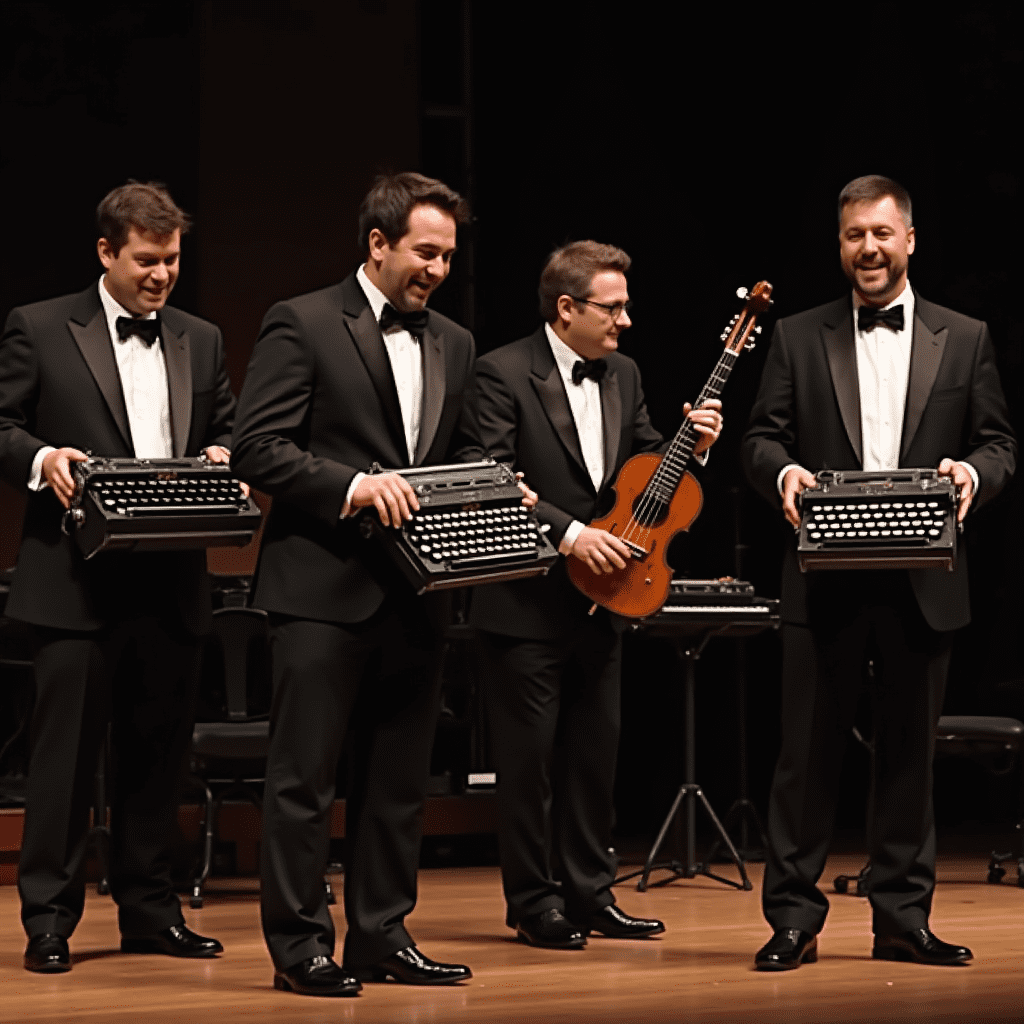
Now, imagine this: a thousand tiny hammers, poised and ready. A cascade of keys, waiting for their moment. A rhythmic, insistent tapping, building to a crescendo. This isn’t the soundtrack to a historical drama; it’s the sound of a live orchestra. An orchestra made entirely of typewriters.
Seriously.
When I first heard about this, I thought it was a prank. A wonderfully elaborate, noise-making prank. But as I dug deeper, I found myself utterly captivated by the reality of it. The very idea is so wonderfully anachronistic, so delightfully unexpected, that it feels like something out of a dream. A dream filled with the satisfying *thwack* of carriage returns and the crisp *ding* of a completed line.
This is the world of the “typewriter orchestra.” And it’s more than just noise; it’s a meticulously crafted art form.
Think about it. Each typewriter, with its unique mechanism, its particular weight of keys, its individual bell, contributes a distinct voice to the ensemble. It’s a fascinating blend of mechanical precision and almost human-like expressiveness. The sheer visual spectacle alone must be breathtaking – rows upon rows of these magnificent machines, their chrome gleaming, their keys poised like so many expectant fingers.
I managed to find some incredible videos online, and let me tell you, seeing and hearing it is something else entirely. It’s not just random tapping. There’s structure, there’s melody, there’s a surprising emotional depth to the sound. The conductors – and yes, they have conductors! – guide the players with intricate gestures, cueing them to strike specific keys, to create rhythmic patterns, to build sonic textures that are both familiar and utterly alien.
One ensemble I came across, a group of dedicated musicians and enthusiasts, has taken this concept to an astonishing level. They don’t just bash away at keys. They compose original pieces specifically for their typewriter orchestra. They experiment with different types of typewriters – from the heavy, industrial giants of decades past to the sleeker, more portable models. Each choice, each instrument, is deliberate.
Imagine the sheer coordination required. A single piece of music might involve dozens, even hundreds, of typewriters playing in unison or in staggered rhythms. The air would be thick with the percussive pulse, a constant, vibrant thrum that wraps around you. It’s a sound that feels both old and new, a testament to human ingenuity and our enduring love for creating something beautiful out of the mundane.
And the materials! These aren’t just any old typewriters. Often, these ensembles use vintage typewriters, each with its own history, its own sonic fingerprint. The clatter of a 1930s Underwood is different from the sharper tap of a 1960s Olympia. This adds another layer of richness to the soundscape, a subtle resonance of the past woven into the present.
The performers, the “typewriterists” as they might be called, aren’t just hitting keys randomly. They are musicians in the truest sense of the word. They understand rhythm, dynamics, and timbre. They learn to control the force with which they strike the keys, the speed of their typing, the way they manipulate the carriage return. It’s a physical performance, a dance of fingers across a keyboard, synchronized to produce something truly remarkable.
What’s truly fascinating is how something as seemingly simple as a typewriter can be transformed into a powerful musical instrument. It forces you to reconsider what constitutes music, what can be used to create sound, and how we perceive it. It’s a beautiful reminder that inspiration can strike anywhere, and that creativity knows no bounds. Who would have thought that the tools of writers and journalists could form the backbone of a symphony?
These performances are often accompanied by visual elements, adding to the immersive experience. The synchronized movement of hands across keyboards, the visual rhythm of the hammers striking the platens, the sheer scale of the assembled instruments – it all contributes to a performance that is as much a feast for the eyes as it is for the ears.
There’s a certain romanticism to it, isn’t there? In an age of digital perfection and synthesized sounds, there’s a raw, tactile beauty to the mechanical. The typewriter orchestra embraces this. It’s a celebration of analog, of the physical act of creation, of the tangible connection between performer and instrument. It’s a powerful counterpoint to the often ephemeral nature of digital media.
It makes you wonder about the possibilities. Could we have string quartets made of sewing machines? Brass bands of old telephones? The imagination truly takes flight when you consider the potential for “found sound” orchestras.
For anyone who appreciates innovation, for lovers of unique sounds, or simply for those who are curious about the unexpected, I highly recommend seeking out videos of these typewriter orchestras. It’s a journey into a world where the familiar becomes extraordinary, where the everyday is transformed into art.
It’s a testament to the fact that music is everywhere, waiting to be discovered, waiting to be orchestrated. And sometimes, that orchestration comes with a satisfying *clack* and a triumphant *ding*.
So, next time you’re feeling a bit stuck for inspiration, or just looking for something truly different, remember the typewriter orchestra. It’s a symphony of clicks and clacks, a testament to human creativity, and a sound that will stay with you long after the last note has been typed.
Have you ever encountered anything like this before? What are your thoughts on this unique musical phenomenon? Let us know in the comments below! We’d love to hear your reactions.