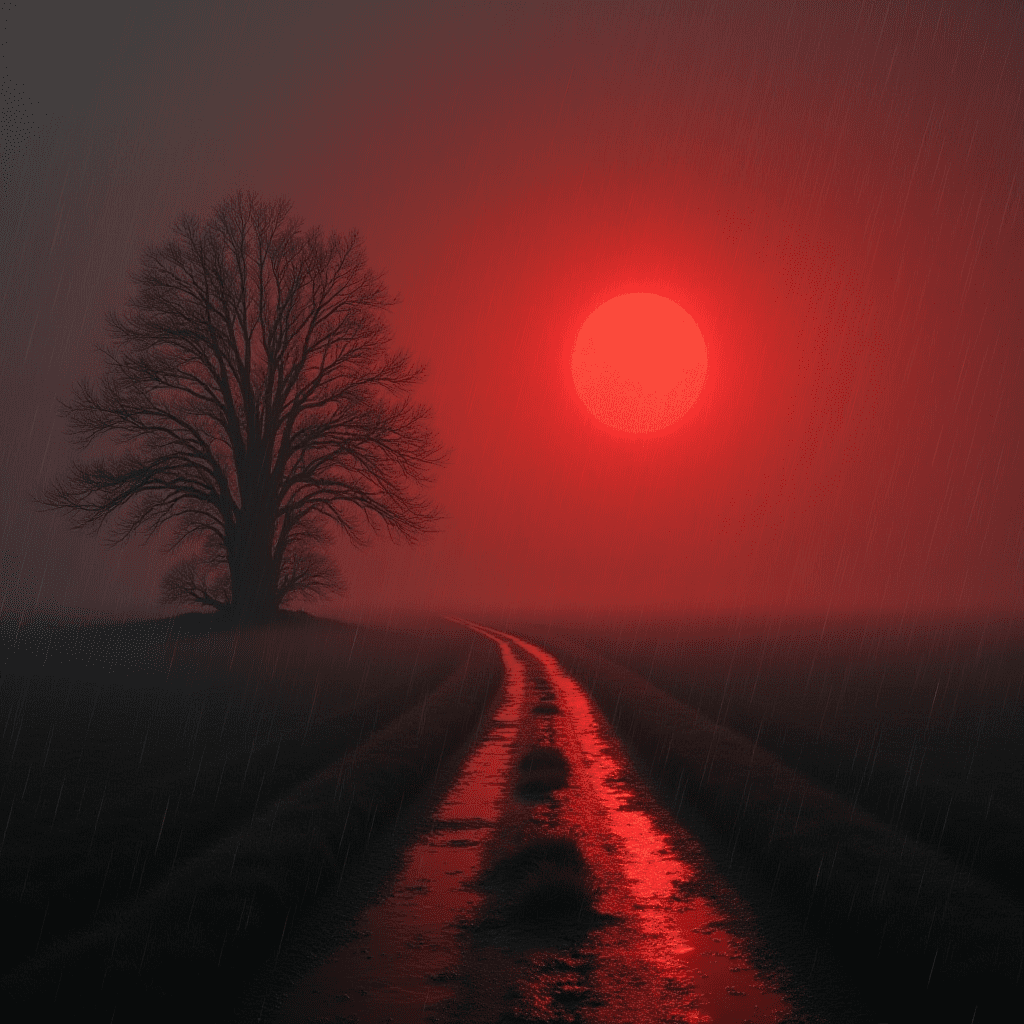
Close your eyes for a moment. Picture a gentle shower, the kind that washes the world clean and leaves behind the scent of damp earth. Now, imagine those same raindrops are… red. Not a faint blush, but a deep, vibrant crimson. The kind of red that makes your heart skip a beat, the kind that whispers of ancient myths and untouched wilderness.
This isn’t a scene from a surrealist painting or a forgotten horror movie. This is a real, albeit rare, phenomenon that has baffled and awed people for centuries: red rain.
It’s the kind of thing that sparks hushed conversations and wide-eyed wonder. When the sky starts to weep tears of red, it’s a moment that halts everything. Life stops, and all eyes turn upward, questioning the impossible.
But what is it? Is it a sign? A curse? Or something far more grounded in the incredible science of our planet?
Let’s dive into this fascinating natural mystery, shall we?
Our journey begins with a visual that’s hard to shake. Imagine a farmer in a remote village, accustomed to the rhythm of the seasons. One afternoon, the clouds gather, dark and heavy, promising much-needed relief. But as the first drops fall, they strike the parched earth, not with the usual clear splatters, but with a startling, rusty hue. The rain is red.
This isn’t just a story from a distant, mythical land. Reports of red rain have surfaced in various parts of the world, from the lush landscapes of Kerala, India, to the windswept plains of Europe, and even across the Atlantic. Each instance, while geographically diverse, shares that same unnerving visual.
The immediate reaction is often fear. Ancient cultures, lacking scientific explanations, attributed such events to divine displeasure, omens of war, or even the blood of fallen gods. It’s easy to see why. When nature deviates so dramatically from the norm, our primal instincts often lean towards the extraordinary.
But as humanity progressed, and our understanding of the natural world deepened, we began to seek rational explanations. And the truth, as it often is, is just as remarkable as any myth.
The secret to red rain lies not in the sky itself, but in what the sky carries.
Think about dust. We see it every day, don’t we? A fine layer that settles on furniture, a swirling cloud behind a passing car. Now, imagine that dust being lifted, not just a few feet off the ground, but thousands, even tens of thousands, of feet into the atmosphere.
This is where the story of red rain truly takes flight. The primary culprit behind this crimson downpour is often microscopic particles of dust, rich in iron oxide. Iron oxide, as many of you will know, is essentially rust. And rust, especially in a finely powdered form, carries a distinctive reddish-brown hue.
So, how does this atmospheric dust get into our rain? It’s a process of nature’s grand conveyor belt.
Powerful winds, often associated with storms or even large-scale weather patterns, can whip up vast quantities of dust from arid or semi-arid regions. These dust storms can be colossal, carrying particulate matter for hundreds, even thousands, of miles.
Consider the Sahara Desert, a seemingly endless expanse of sand and rock. When the winds are right, enormous clouds of Saharan dust can be lifted into the upper atmosphere. These particles can then be carried by prevailing winds, like the jet stream, across continents and oceans. It’s a truly global phenomenon.
When rain clouds form within these dust-laden air masses, the tiny iron oxide particles get incorporated into the water droplets. As these droplets grow and eventually fall as rain, they carry their colourful cargo with them.
The result? A spectacular, albeit unusual, shower of red rain.
The intensity of the red colour depends on several factors. The concentration of the iron oxide dust is key. More dust means a deeper, more vibrant red. The size of the dust particles also plays a role, with finer particles being more easily suspended in the air and dispersed.
Even the type of dust can influence the colour. While iron oxide is the most common cause, other mineral dusts with different compositions can lead to variations in colour, sometimes even a yellowish or brownish tint.
One of the most well-documented instances of red rain occurred in Kerala, India, between July and September of 2001. For weeks, the region was showered with red rain, sparking widespread concern and scientific investigation. Initially, theories ranged from alien spores to chemical pollution. However, extensive research by the Indian Institute of Tropical Meteorology concluded that the colour was primarily due to airborne red dust particles, likely originating from the Arabian Peninsula, carried by monsoon winds.
This event highlights how atmospheric circulation patterns can transport these particles over vast distances, making red rain a global possibility, even if it’s more common in certain regions prone to dust storms.
Beyond the iron oxide dust, there are other, less common, causes for coloured rain.
Sometimes, the rain can take on a red hue due to the presence of algae spores or pollen. Certain types of red algae, when released into the atmosphere in large quantities, can get mixed with rainwater, giving it a reddish or even pinkish tint. Similarly, a heavy concentration of red-hued pollen from specific plants during their blooming season can also contribute.
These biological explanations are fascinating because they connect the colour of the rain to the life cycles of microscopic organisms and plants, adding another layer to nature’s intricate web.
It’s important to note that while visually striking, red rain caused by mineral dust is generally not harmful. The particles involved are typically inert and pose no significant health risk. However, as with any unusual environmental event, it’s always wise to exercise caution and consult scientific sources for accurate information.
Think about the sheer scale of this process. We’re talking about winds strong enough to lift microscopic particles thousands of miles, carrying them on invisible currents across the globe, only for them to be washed down by rain. It’s a testament to the immense power and interconnectedness of our planet’s systems.
For those who witness it, red rain is an unforgettable experience. It’s a moment where the familiar sky transforms into something otherworldly, prompting reflection on our place within the vast, mysterious workings of nature. It reminds us that even in the most ordinary of phenomena, like a simple rain shower, there can be extraordinary stories waiting to be uncovered.
So, the next time you hear about red rain, you’ll know it’s not a harbinger of doom, but a striking display of atmospheric science and geological processes at play. It’s nature, in its most vibrant and unexpected colours, painting the sky with stories carried on the wind.
It truly is a ForRealPost worth pondering, isn’t it?
Have you ever witnessed anything like red rain, or perhaps another unusual weather phenomenon? Share your experiences in the comments below! We’d love to hear your stories and thoughts on this incredible planet we call home.